Omarchy Mobile: CyanogenMod First, Ecosystem Second
The phone is the last computer you cannot change the software on. You have replaced the operating system on every laptop you have ever owned, and there is a good reason almost nobody does it on a phone: the OS arrives welded to the hardware, the updates land on Google's schedule, and the bootloader is locked against you.
There is one precedent for changing that, and I think Omarchy Mobile is pointed straight at it.
This is a proposal for where Omarchy Mobile should go next. Short version: stage two is an agent-first phone with an app store, a marketplace, behind it. You ask for what you need, the agent finds the existing app or builds one, and it publishes to the marketplace only with your consent.
CyanogenMod already did this once
CyanogenMod, from 2009, let you flash any Android phone with someone else's build of Android. It never became a business. It became something better: a movement. When Cyanogen Inc. shut down in 2016 the community forked it into LineageOS, which today runs on the order of 4.5 million devices, keeps working on hardware Google abandoned years ago, and has now long outlived the company that started the whole thing.
The lesson is not that custom ROMs are a business. It is the shape of how a phone OS gets made: first as software you install onto someone else's hardware, and only later as hardware someone builds for you.
The first half of that shape is already done for Omarchy.
Stage one is already happening
Omarchy Mobile is a community project that runs native Omarchy on a phone: Arch Linux ARM, Hyprland and Omarchy's own packages, on a mainline Linux kernel, with no Android underneath at all. It is MIT licensed, it is not an official Omarchy or Basecamp product, and it is genuinely good work.
The reference device is a Pixel 7 Pro, and the project's page now reports 22 of its 22 hardware subsystems working: display, GPU, touch, Wi-Fi, Bluetooth, cameras, GPS, fingerprint unlock, NFC, charging and the rest. The same page lists thirteen phones in all. The Pixel 9a is at 18 of 22 and the Pixel 6 Pro at 14 of 22, and most of the rest are still at the start.
The safety model is what makes this flashable rather than merely impressive. Omarchy Mobile only ever lives on the phone's second boot slot. Stock Android stays on the other one, so there is always a known-good system to fall back to. Installing erases userdata, but it cannot brick the phone.
The shell is already built for a touchscreen: lock screen, notifications, home screens with widgets, messages, calls, a camera, and a terminal with the AI agent you pick at first login. The widget sheet even has a button to make a widget with AI.
Stage one, then, is not a proposal. It is a port, with a safety model, and a community. Which leaves the part that is missing.
Stage two: an agent-first phone with a marketplace
The phone has an agent on it, the agent can write software, and on Omarchy an app is just a package. That makes the app store and the agent one system, not two. Here is the idea, as a flow.
You ask for something. "Track my kids' swimming lessons and remind me the night before." "Show me this month's electricity use next to last year's." The agent is the front door to the marketplace, so you do not have to browse it.
First the agent looks in the marketplace for an app that already does what you want. If someone has published one, it installs that one, and you get a signed package instead of something generated on the spot.
If nothing fits, the agent builds the app. It writes the code, tests it, fixes it, and installs it on your phone as a real app. This is where Omarchy's shape helps. omarchy update is already the distribution channel, with signed repositories, on the phone as much as on the laptop. A published app could be a pacman package, a Hyprland widget, a shell plugin or a skill for the agent, and the phone's own packages are meant to ship from a repository of their own beside Omarchy's.
Then the agent asks one question: do you want to publish it? Publishing happens only with your consent, and nothing leaves your phone unless you say yes. Say yes and the app goes to the marketplace for the next person who asks for the same thing. Say no and it stays yours.
That last step is what makes the marketplace grow. It starts nearly empty, and every missing app that gets built and published fills it a little more.
The marketplace does not exist yet. There is an unofficial directory for desktop Omarchy that indexes 205 packages and installs them with omarchy pkg add; it hosts nothing and sells nothing. For mobile there is nothing at all. The suggestion is to build the marketplace with the publish path in it from day one (fork a template, omarchy pkg add, or push to your own repository), so the agent can both find apps and publish new ones.
What Blue and Cyclon each get right
Two startups are building AI phones, and they disagree in a way that is useful.
Blue took the other route. Blue OS is a heavily modified, security-hardened Android that runs the Google Play Store, so the apps you already use come with you, and the agent works across them. It triages notifications, drafts replies in your voice, keeps a memory of the people and places in your life, and runs background tasks such as chasing a receipt or disputing a charge while you do something else. It does this by operating the real apps on the phone, using the sessions you are already logged into, which is how it gets past the bot protection that blocks a chatbot on the web.
That is a strong answer to the app gap, because it makes the existing ecosystem the product. It also costs something, and Blue says so in its own privacy page. To operate an app, the phone captures the screen and sends it to Blue's servers and on to an AI provider. Your texts, contacts and photos sync to a Blue cloud, including the two-factor codes that arrive by SMS. I am not calling that a flaw. It is the price of an agent that has to work through other people's interfaces.
Blue's alpha batch has sold out, and the second is shipping now through December. The beta is a Pixel 10 Pro or Pro XL running Blue OS at $1,299, or free if you trade in an iPhone within 30 days. Their own hardware is planned for the public launch in 2027, with a $100 refundable deposit.
Cyclon is a Y Combinator F26 company with a different bet: the phone builds the app you were missing. When it announced itself, it put a $199 refundable deposit toward an estimated $699 phone. Their own hardware is expected in Q2 2027, and the first batch ships as a Pixel 8a running Cyclon OS. The agent writes the code in a sandbox, tests it, fixes it and installs it as a real app, and those apps can call third-party APIs.
Cyclon is the closest to what I am proposing, and it also keeps the apps you already use and works inside them. Blue shows how much a phone agent can do with the apps that already exist. Cyclon adds that it can make new ones. Omarchy Mobile can do both, and has one thing I could not find on either site.
Neither of them has to build an ecosystem, because both lean on Android's. Neither site says anything about a way to share what the agent builds. An agent-first Omarchy phone could add that third piece: a marketplace where what one person's agent builds is available to everyone, if its author chooses.
There is a second difference, and it is the one I care about more. On Android, an agent has to work by looking at the screen and tapping, because apps are sealed boxes. On Omarchy, apps are packages with command lines and files the agent can read. It does not need to screenshot your phone to do the job. It can call the tool. That makes it faster and more reliable, and it means the agent you pick at first login can run on your phone rather than behind someone's server.
None of this is free. Banking and payment apps, and anything that wants a Google-certified phone, will not run on a phone without Android. Blue and Cyclon are both honest about that kind of limit, and an Omarchy phone would have the same one. Waydroid could cover some Android apps, but nothing runs on the phone yet, so it is a plan and not a promise.
Stage three: a manufacturer
Eventually a manufacturer is needed, because some problems cannot be solved by a community: bootloader unlock, modem certification, Play Integrity, security patches, volume. You cannot ask people to unlock the bootloader of the phone they just bought and then hope they feel safe about it.
Both startups are running their OS on a Pixel today while they build the phone. Software first on someone else's hardware, hardware later, is now the standard playbook, and Omarchy's advantage is that it does not need a factory to start.
The proposal, in three stages
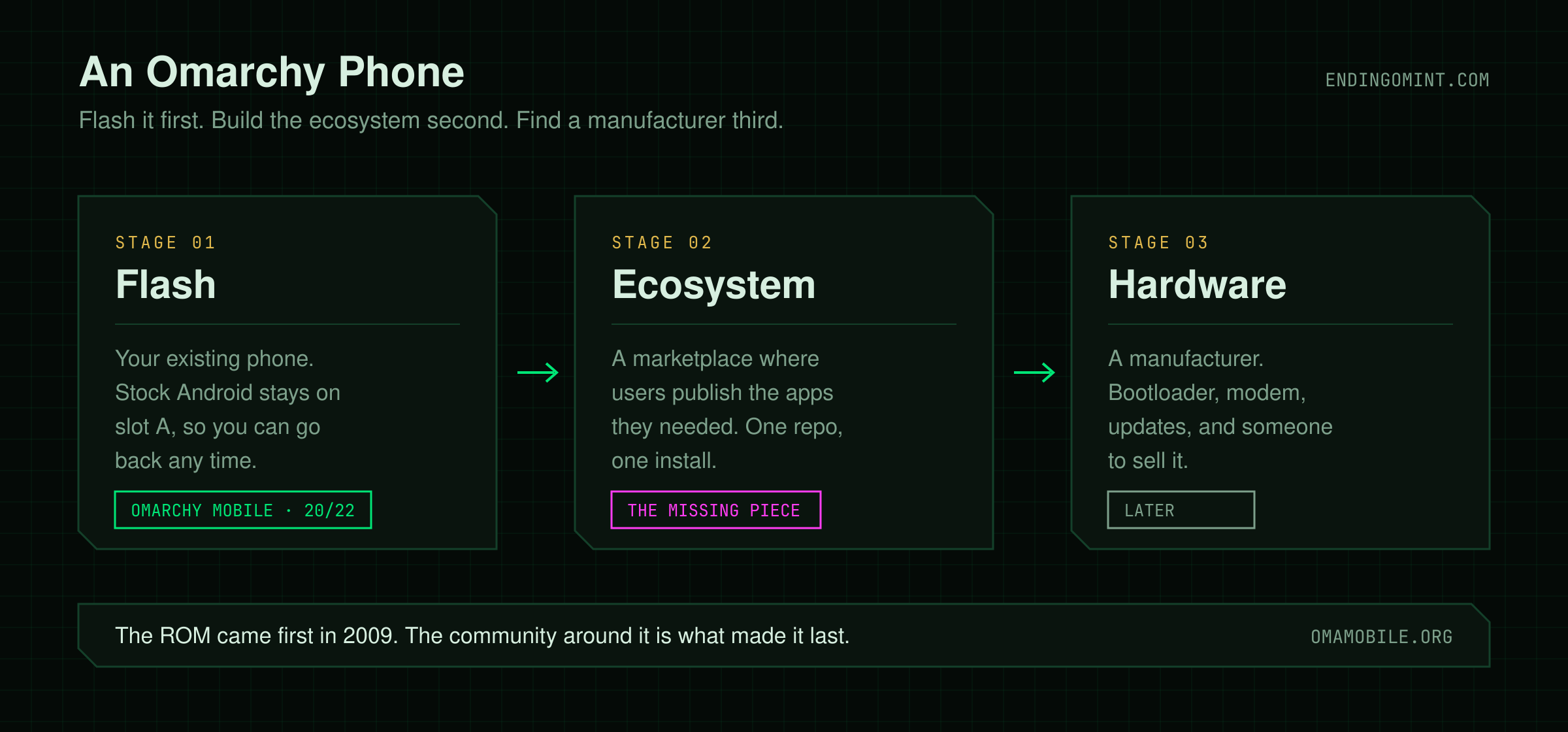
Stage one. Flash existing phones with Omarchy Mobile, and help more ports land. Already happening.
Stage two. An agent-first phone with an app store, a marketplace. The agent finds the existing app you want or builds one, and publishes it to the marketplace with your consent. The missing piece.
Stage three. Work with a phone manufacturer.
Stage one is being done, competently, by people who love it. Stage three needs a factory and a balance sheet. Stage two needs almost nothing but the willingness to build it, and it is the stage that decides whether an AI-native phone is a nice demo or something people actually carry.
Omarchy has already proved it can be an OS people want to live in. A phone is the same argument, and the port already exists. If you want to take this further, I would happily help build the agent-first marketplace part.
~ Mike